7 Best Homelab Projects for Beginners: Start Self-Hosting Today
Have you ever been captivated by the idea of running your own servers, hosting your personal apps, and finally taking back control of your data? Setting up a personal home server remains one of the most fulfilling ways to dive hands-first into IT, networking, and DevOps. That said, staring at photos of massive, complex racks of enterprise equipment can feel incredibly intimidating for newcomers.
Far too many aspiring tech enthusiasts wind up trapped in “tutorial hell,” entirely unsure of where they should actually begin. Choosing the right best homelab projects for beginners is the ultimate key to skipping that initial frustration. Rather than dropping thousands of dollars on enterprise gear or accidentally tearing your home network apart, you can easily start small by focusing on practical setups that offer a high impact.
Throughout this guide, we are going to break down exactly why building a personal server often feels so overwhelming, while also exploring the specific projects you should prioritize first. From blocking intrusive ads across your entire network to hosting your very own streaming service, let’s dive right into the ultimate self-hosting journey.
Why Getting Started With the Best Homelab Projects for Beginners Feels Overwhelming
When you first start looking into self-hosting, it often seems as though you need an advanced degree in computer science just to get a basic server up and running. Why is this such a common roadblock? More often than not, the core issue boils down to a frustrating mix of decision paralysis and overly complex documentation.
A vast majority of online tutorials simply assume you already have a firm grasp on concepts like containerization, reverse proxies, and subnets. Because of this, when beginners try deploying what should be a straightforward application, they suddenly find themselves deep in the weeds troubleshooting Docker daemon errors or fixing broken network bridges. Quite frankly, it is incredibly easy to accidentally knock out your home’s internet connection while you are just trying to experiment.
On top of that, newcomers have a tendency to take on way too much all at once. An enthusiastic beginner might attempt to configure a bare-metal hypervisor, deploy a network-wide firewall, and spin up ten different microservices—all over the course of a single weekend. Naturally, this ambitious pace leads straight to burnout. A much better approach is to tackle just one discrete, isolated project at a time.
Quick Fixes & Basic Solutions: Easy Beginner Projects
If your goal is to see fast results without needing a wealth of deep technical knowledge, this is exactly where you should start. Taking these actionable steps will provide an immediate return on whatever hardware investment you have made. Below, we have outlined the easiest entry-level projects to help you kickstart your NAS setup and breathe life into your personal server environment.
- Network-Wide Ad Blocking (Pi-hole)
Operating as a DNS sinkhole for your entire network, Pi-hole is an absolute game-changer. By simply routing your DNS requests through it, you can instantly strip away annoying advertisements and hidden tracking scripts from every device in your home. Even better, it runs flawlessly on a cheap Raspberry Pi or within a lightweight Linux container. - Your Personal Cloud Storage (Nextcloud)
Are you getting tired of paying monthly fees for Google Drive or iCloud? Nextcloud serves as a brilliant open-source collaboration platform, allowing you to seamlessly sync files, photos, and calendars across all of your devices. Getting this set up is a fantastic way to introduce yourself to basic web server management and database configuration. - Home Media Server (Jellyfin or Plex)
You can actually turn that dusty old desktop sitting in your closet into a personalized version of Netflix. By installing a platform like Jellyfin (which is fully open-source) or Plex, you gain the ability to stream locally stored movies and TV shows directly to any smart TV, tablet, or mobile device. This is a highly rewarding project because it provides tangible results that your friends and family can actually enjoy. - Password Management (Vaultwarden)
Vaultwarden offers a beautifully lightweight, self-hosted alternative to the popular Bitwarden service. When you host your own password manager, you get to keep all of your most sensitive credentials strictly in-house, entirely bypassing the need to trust a third-party cloud provider with your private data.
Advanced Solutions: Leveling Up Your IT Skills
Once you feel perfectly comfortable deploying those basic applications, it is time to push your boundaries and move on to more technical fixes. Interestingly, these advanced solutions cover the exact skills that are highly sought after from an IT and DevOps career perspective. Taking these next steps will effectively transform your simple home server into an enterprise-grade learning laboratory.
1. Implement a Type-1 Hypervisor (Proxmox Virtualization)
Rather than installing a standard operating system like Ubuntu directly onto your mini PC, consider giving Proxmox Virtual Environment a try. Proxmox virtualization operates as a remarkably powerful hypervisor platform, allowing you to spin up multiple independent Virtual Machines (VMs) and LXC containers all on one single physical machine. The major benefit here is isolation; if you accidentally break one of your VMs during an experiment, the rest of your server ecosystem stays completely intact.
2. Master Containerization (Docker Containers)
There is no denying that Docker completely revolutionized the modern tech industry. For any aspiring homelabber, learning how to smoothly deploy services using Docker Compose files is an absolutely essential skill. To make things easier on yourself, try pairing your Docker containers with Portainer. This graphical user interface provides an incredibly intuitive way to manage your containers, downloaded images, and persistent network volumes.
3. Secure Access via Reverse Proxy (Nginx Proxy Manager)
Eventually, the day will come when you want to access your shiny new homelab securely from outside your house. However, blindly opening random ports on your home router is a massive security risk that you should avoid at all costs. Instead, look into setting up a reverse proxy like Nginx Proxy Manager or Traefik. These brilliant tools intelligently route incoming traffic through a single, securely encrypted port while automatically provisioning free SSL certificates for your domains via Let’s Encrypt.
Homelab Best Practices for Optimization and Security
For anyone stepping into the role of a system administrator, performance optimization and network security need to be at the very top of your priority list. Unfortunately, a poorly secured homelab makes for a tantalizingly easy target for automated botnets prowling the web. To keep your data safe, always do your best to adhere to the following best practices.
- Use a Mesh VPN: You should never expose sensitive administrative interfaces—like your Proxmox dashboard or Portainer instance—directly to the public internet. Instead, rely on a zero-trust mesh VPN such as Tailscale or WireGuard. This allows you to securely access your local network from anywhere in the world without compromising your security.
- Automate Your Backups: Hardware failure is an inevitable reality of working in IT; it is never a matter of if a drive will fail, but when. Protect yourself by following the golden 3-2-1 backup rule. Utilize reliable tools like Proxmox Backup Server, or even simple automated rsync scripts, to ensure your critical container data is safely backed up to an external drive or remote cloud storage.
- Monitor Resource Usage: Consider deploying a robust monitoring stack utilizing Prometheus and Grafana. Taking the time to set this up allows you to beautifully visualize your real-time CPU consumption, RAM utilization, and network bandwidth. Ultimately, it helps you identify glaring bottlenecks long before they have the chance to crash your server.
- Isolate Traffic with VLANs: If your current router supports the feature, it is highly recommended to segregate your smart home IoT devices onto a separate Virtual LAN. Doing so effectively walls off your network, preventing something as trivial as a compromised smart bulb from gaining access to your highly sensitive personal files.
Recommended Tools and Resources
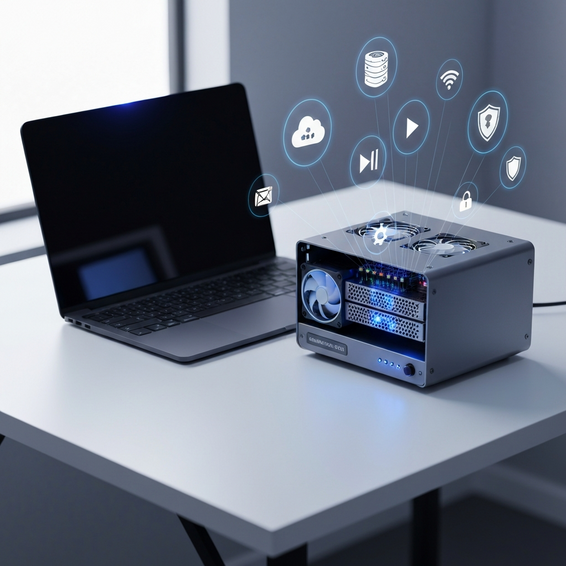
You absolutely do not need a massively expensive, power-hungry server rack to build out a fantastic self-hosted environment. In fact, optimizing for low power consumption is usually the smartest move you can make for a home setup. If you are looking to get started, here is the hardware we strongly recommend considering.
- Raspberry Pi 5: This is widely considered the perfect ultra-low-power board. It is an exceptionally great choice for running Pi-hole, hosting Home Assistant, or operating as a highly efficient, lightweight Docker host. (Check price on Amazon)
- Beelink or Intel NUC Mini PCs: If your goals include running Proxmox or a dedicated media server, grabbing an Intel N100 or i5-based mini PC is the way to go. These tiny machines offer incredible processing performance at just a fraction of the power cost associated with a bulky desktop tower. (Check price on Amazon)
- Synology NAS: For those who primarily care about rock-solid file storage and effortless automated backups, a Synology 2-bay NAS remains the undisputed gold standard for beginners in the space. (Check price on Amazon)
- Network Switches: You do not need anything fancy to tie it all together; a simple, unmanaged 8-port gigabit switch from a brand like TP-Link provides all the connectivity you need to wire up your new server nodes efficiently.
FAQ Section
What is a homelab?
At its core, a homelab is simply a personal server or custom network environment that you build within your own home. Enthusiasts typically use them for learning complex enterprise IT concepts, safely testing new software, hosting personal web applications, and, ultimately, taking full control over their own data privacy.
How much does a beginner homelab cost?
Believe it or not, a basic setup can cost absolutely nothing at all if you are willing to repurpose an old laptop or a dusty desktop computer you already own. However, if you prefer to purchase dedicated, power-efficient hardware from the start, items like a mini PC or a Raspberry Pi will typically run you anywhere from $50 to $200.
Is running a homelab safe?
Yes, running your own server is very safe, provided that you diligently follow basic security principles. Always make sure to keep your software actively updated, enforce strong password policies, and strictly avoid opening ports on your home router unless absolutely necessary. For remote access, utilizing a secure mesh VPN like Tailscale is highly recommended.
Do I need to know how to code to run a home server?
You will be happy to hear that zero programming experience is required! While picking up a bit of command-line Linux knowledge and learning how to read YAML files certainly helps, plenty of modern self-hosting tools feature incredibly intuitive web-based dashboards. This often makes the entire installation process as simple as pointing and clicking.
Conclusion
Taking those first steps into the world of self-hosting definitely does not have to be an intimidating ordeal. By shifting your focus toward discrete, highly manageable tasks, you can rapidly piece together a wonderfully functional IT environment. Whether your ultimate goal is to permanently block pesky network ads, stream your own media, or dive deep into enterprise-level virtualization, there truly is a perfect entry point out there for everyone.
Always keep in mind that the best homelab projects for beginners are ultimately the ones that solve a genuine problem in your everyday life. Go ahead and grab an old PC, install a lightweight Linux distribution or load up Proxmox, and try spinning up your very first Docker container today. The hands-on, practical experience you stand to gain will prove invaluable—not just for reclaiming your personal privacy, but for supercharging your technical career as well.
About the Author